The game development pathway: six leaps, and what each one needs
A player stagnates, then jumps ahead: Hrvoje Zmajic turns that into a model. Six levels of game, each opened by a leap you prepare with specific “drivers” and confirm in a match.
Hrvoje Zmajic (Croatia) LinkedIn · 2026 · ITF Coaching & Sport Science Review n° 98
Based on Hrvoje Zmajic (2026), Tennis game development pathway, ITF Coaching & Sport Science Review, vol. 34, n° 98, p. 5-10.
Download the article (PDF) Read the original article
DOI 10.52383/itfcoaching.v34i98.753 · CC BY 4.0
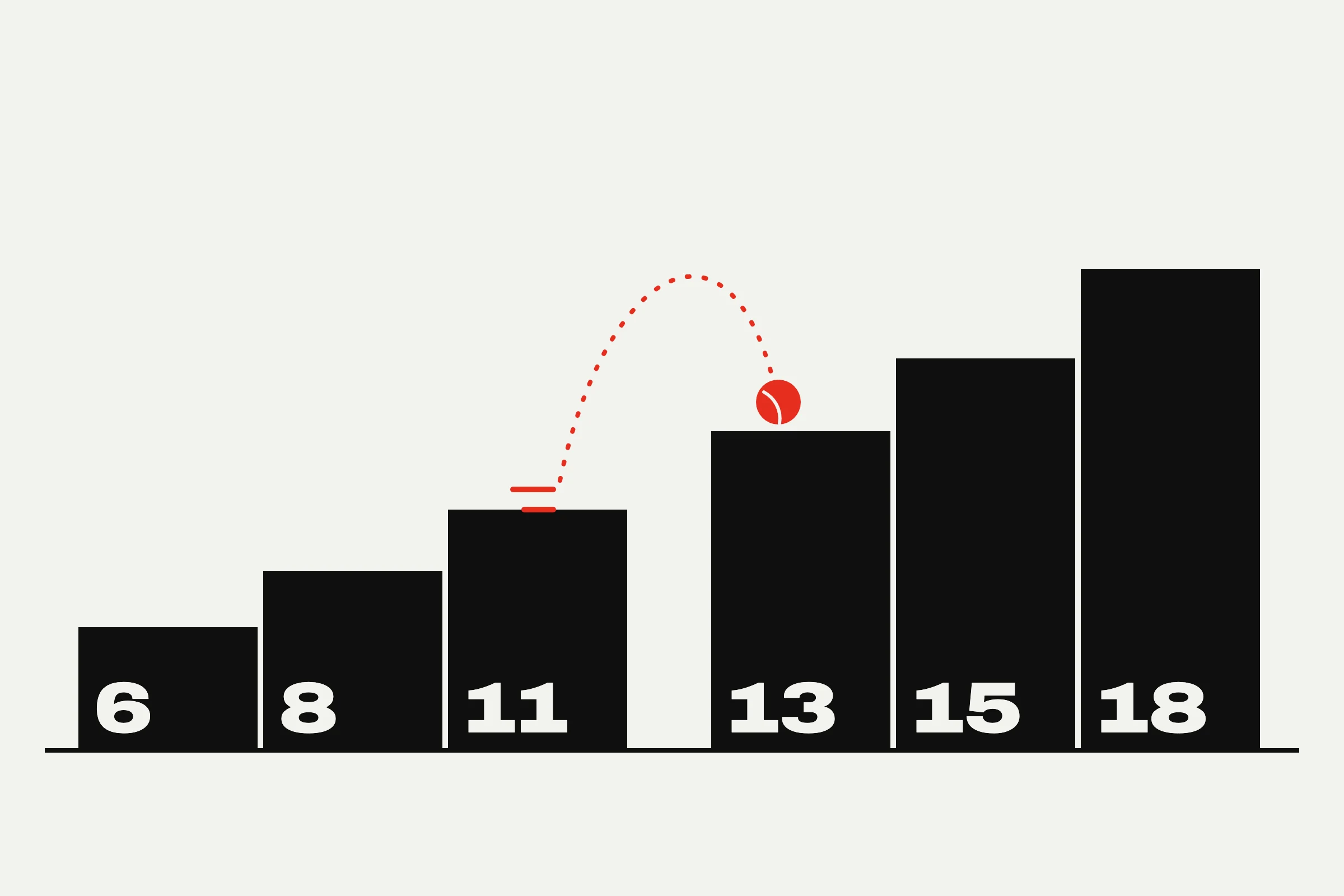
A Saturday morning, an eleven-year-old who has trained hard for months is going nowhere. The parents worry, the coach doubts. Three weeks later, with nothing spectacular changed, they start taking the ball earlier and winning points they used to lose: they have leapt.
The article does not tell this scene, it is our illustration, but it gives the key: you work, nothing moves, then everything moves at once; it asks the coach whether they have ever experienced this. Hrvoje Zmajic makes a model of it, the “game pathway”: instead of asking how old the player is, ask at what level of game they are, and what they need to move up.
In 2 minutes
Our reading: a framing text, with no experiment or sample. The author, who also educates coaches, offers a framework he calls original. It rests on dynamic systems theory: the game is a complex system, where body growth, cognition, emotions, motivation, tactics, skills and competition act together, which makes it reasonable to expect periods of rapid improvement, fluctuations, sometimes setbacks.
He compares his pathway with the classic long-term player development model (LTPDM, from Tennis Canada). That one describes the child, age and “windows of opportunity”: a user manual of what can be done at a given age. The pathway describes the game, its qualitative changes and the criteria to recognise them: a process manual of what to do to reach the next level.
Six levels are proposed, each with an essential driver and a new quality: the competitive rally (from 6-7 years), using open space (8-9), space and time (11-12), a weapon (13-14), imposing your own game style (15-16), managing match flow (18-19). The ages show when the drivers are usually ready, not norms.
The method is a cycle: identify the player’s level, have them acquire the drivers for the next one, play official competitions, detect the playing competencies there. The leap is confirmed in a match, by expert judgement or measurable indicators. To illustrate, the author details the first level: four match competencies with numerical thresholds and the matching drivers. He ends by admitting the framework still needs validating by research.
- Our assessment
- Level of evidence : 1 out of 5 · Practitioner experience
This is an original framework proposed by a coach educator, resting on developmental psychology and dynamic systems work, but with no player data: the author himself writes that the levels and their drivers remain to be validated. A good reading grid, not a demonstration.
This level does not say the idea is wrong: it says how well it is demonstrated.
The ideas, one by one
- 01
Progress comes in leaps
- 02
A system where everything acts on everything
- 03
The drivers of the leap
- 04
Six levels of game
- 05
Ages as guidelines, not rules
- 06
From user manual to process manual
- 07
The match confirms the leap
- 08
A first level with numbers
- 09
Motivation, competition, equipment: the game also moves through these
For subscribers
The full note, linked to the workshop
Each idea in detail, on-court advice with its diagrams, ready-to-run drills, the coach’s view and the article’s limits.
- 9 ideas in detail
- 24 on-court tips
- 12 workshop drills
Keywords
Further reading
On Seconde Balle
- The “game pathway” drills →One drill per level, from the rally for the score to the flow of the match, drawn and animated in the workshop.
- Plan your junior programme →White to green, one block per colour: the pathway gives the criteria for moving from one to the next.
- Teen blocks: from weapon to game style →The article’s levels for ages 13 to 19, turned into sessions for club teenagers.
- A game plan before a match that matters →Three rules, a plan B, twenty minutes on video to rehearse them.
- For clubs →A shared grid of game levels for the whole teaching team, from junior programme to competition.
- All notes by Hrvoje Zmajic →Croatia
- Notes on « Juniors » →Articles for coaches
- Notes on « Tactics » →Articles for coaches
- Notes on « Coaching methods » →Articles for coaches
In the journal
- Executive functions: training the head to stay clear →The last level of the pathway rests on emotional regulation: that note links self-regulation (attention, emotion, effort) to executive functions, inhibition among them, and proposes training them on court.
- Using time pressure in your sessions: 7 reasons →The “space and time” level is about taking time away from the opponent: here are practical settings to put the player under time pressure in training (balls taken on the rise, players brought closer).
- Tall and short: two ways to reach the same level →Same issue · Bryan J. Lehecka
- A lower shoulder in a player: tennis adaptation, or a sign of scoliosis? →Same issue · Rodolfo Lisi
- Break points: the points that get saved are short points →Same issue · Andrej Grubisic, Nauman Haq, Robert Raguz, Rafael Martínez-Gallego
- Club culture: what national federations can teach a club →Same issue · Ana Piquer Piquer, Manrique Rodríguez Campos, Andrés Crespo Dualde
- Throw at a target, serve faster? A Hungarian pilot study →Same issue · Károly Dobos, János Péter Tóth, Katalin Orbán-Sebestyén, Csaba Ökrös
- Deception in tennis: fooling, and not being fooled →Same issue · William O’Connell
- Women players at the club: obstacles that are not only on the court →Same issue · Yannick Zaputovich
Also worth reading
- Farrow and Reid (2010), The effect of equipment scaling on the skill acquisition of beginning tennis players: the effect of scaled equipment on beginners, cited by the article. DOI
- Buszard et al. (2020), Scaling sports equipment for children promotes functional movement variability: children’s scaled equipment, seen from the movement side. DOI
- Vilela Brito (2020), Biological age vs. chronological age: the impact on the development of the young tennis athlete. Same journal, issue 80: biological versus chronological age, cited by the article on cognitive development. DOI
- Perri et al. (2023), Macro periodisation of competition in international women’s tennis: the periodisation of competition among international women players, and what it tells us about long-term development. DOI
- All notes →