Throw at a target, serve faster? A Hungarian pilot study
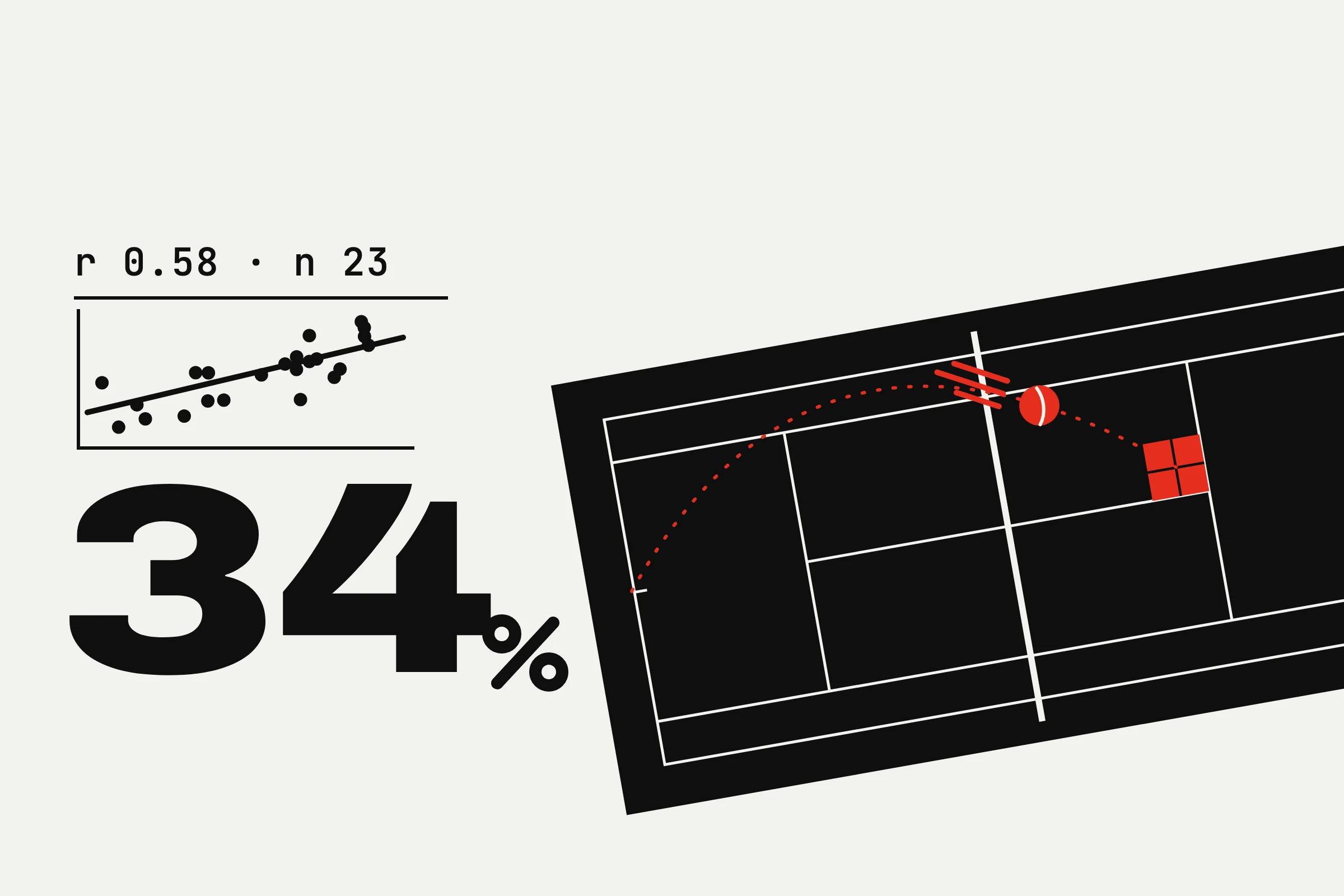
Hungarian juniors threw a ball one-handed at a service-box target, then served. The faster the throw, the faster the serve tended to be: a simple field test, from which the authors draw a lead for drills, to be taken with care in our view.
Károly Dobos (Saint John Apostle Catholic Elementary School and Kindergarten, Hungary) · János Péter Tóth (PhD student, Department of Sport Games, Hungarian University of Sports Science, Hungary) LinkedIn · Katalin Orbán-Sebestyén (Hungarian Tennis Federation (Head of Children’s Tennis), Hungary) LinkedIn · Csaba Ökrös (Hungarian University of Sports Science, Department of Sport Games, Hungary) · 2026 · ITF Coaching & Sport Science Review n° 98
Based on Károly Dobos, János Péter Tóth, Katalin Orbán-Sebestyén, Csaba Ökrös (2026), The relationship between one-hand overhead ball throw aimed at target area and maximal ball speed of flat serve in elite junior tennis players: a pilot study, ITF Coaching & Sport Science Review, vol. 34, n° 98, p. 45-48.
Download the article (PDF) Read the original article
DOI 10.52383/itfcoaching.v34i98.751 · CC BY 4.0
Saturday, 10 am, the second hour of serve work with a group of teens. A fourteen-year-old has been serving “flat out” for ten minutes: half the balls in the net, the rest short of the promised pace. The coach hands over a tennis ball: “Throw it into the square, no racket.” The throw is quick, loose, and the ball drops into the target. The next serve tightens up again.
This scene is ours, not the article’s. Yet it asks the article’s question: does throwing teach the serve anything? The authors of the study took a closer look at the link between the two speeds, with two simple field tests: throws, serves, a radar, a target.
In 2 minutes
The authors (Dobos, from an elementary school in Budapest; Tóth, a PhD student, and Ökrös, from the Hungarian University of Sports Science; Orbán-Sebestyén, head of children’s tennis at the Hungarian federation) start from a simple point: the serve weighs heavily in a match, juniors included, and post-impact ball speed is one of its most decisive components. Several studies had already linked throws (one-handed, two-handed) to serve speed. But those throws were not aimed at a zone the way a serve is. Here the throw is aimed at a target, which brings in conscious control of the movement. The authors also remind us the serve is a complex action: every link of the chain counts, and so does the timing between them, not to mention ball placement; dynamic balance and feedback from the body’s sensors, for their part, may weigh more when the movement is aimed at a target. They also set out a principle of efficiency: in the preparation period, a training tool should improve performance in the short term without jeopardising the young player’s long-term development.
- Our assessment
- Level of evidence : 3 out of 5 · Observational study
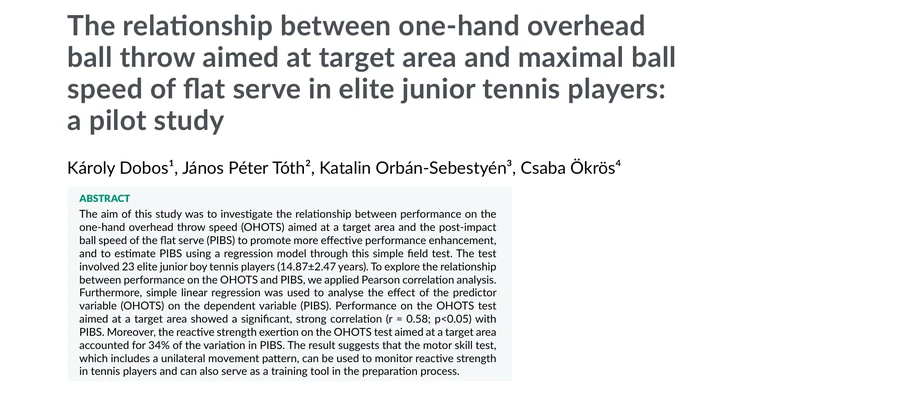
This is a pilot correlation study: 23 elite Hungarian boys, no training tested. It says that throwing fast at a target and serving fast go together, not that practising throwing makes you serve faster.
This level does not say the idea is wrong: it says how well it is demonstrated.
The ideas, one by one
- 01
A throw that aims like a serve
- 02
A simple, precise protocol
- 03
A real link, but a third of it
- 04
The serve is not just about strength
- 05
Conscious motor control
- 06
Vary the forms of throwing
- 07
A throw is not a serve
- 08
Isolate the arm and shoulder
For subscribers
The full note, linked to the workshop
Each idea in detail, on-court advice with its diagrams, ready-to-run drills, the coach’s view and the article’s limits.
- 8 ideas in detail
- 20 on-court tips
- 7 workshop drills
Keywords
Further reading
On Seconde Balle
- The throwing and serving drills →From the seated throw to the field test: the five drills drawn from this note, in the workshop.
- Teen blocks →Sessions where the serve has its place from the start, with real targets.
- Plan your junior programme →Hand throwing is part of the first serve games, from white to green.
- A coach for your serve →An outside eye on the action, the targets and the speeds, on video or on court.
- For clubs →A simple field test to repeat each term with a whole competition group.
- All notes by Károly Dobos →Saint John Apostle Catholic Elementary School and Kindergarten, Hungary
- All notes by János Péter Tóth →PhD student, Department of Sport Games, Hungarian University of Sports Science, Hungary
- All notes by Katalin Orbán-Sebestyén →Hungarian Tennis Federation (Head of Children’s Tennis), Hungary
- All notes by Csaba Ökrös →Hungarian University of Sports Science, Department of Sport Games, Hungary
- Notes on « Strength & conditioning » →Articles for coaches
- Notes on « Biomechanics » →Articles for coaches
- Notes on « Juniors » →Articles for coaches
In the journal
- Tall and short: two ways to reach the same level →A case study of two female players: the taller one serves faster (74 vs 67 mph). Our reading: a hint that height matters, not proof; one more reason to compare a player only with themselves.
- A lower shoulder in a player: tennis adaptation, or a sign of scoliosis? →Lisi deals with the load that the serve and forehand put on the shoulder. Thinking of repeated throws is our own extension: worth reading before adding them to every session.
- The game development pathway: six leaps, and what each one needs →Same issue · Hrvoje Zmajic
- Executive functions: training the head to stay clear →Same issue · Francesco Di Muccio, Lionel Grossenbacher
- Break points: the points that get saved are short points →Same issue · Andrej Grubisic, Nauman Haq, Robert Raguz, Rafael Martínez-Gallego
- Club culture: what national federations can teach a club →Same issue · Ana Piquer Piquer, Manrique Rodríguez Campos, Andrés Crespo Dualde
- Using time pressure in your sessions: 7 reasons →Same issue · Luke Regan
- Deception in tennis: fooling, and not being fooled →Same issue · William O’Connell
- Women players at the club: obstacles that are not only on the court →Same issue · Yannick Zaputovich
Also worth reading
- Dobos and Nagykáldi (2017), The relationship between distance of overhead ball throw and maximum ball speed of serve in elite junior tennis players. Same journal, issue 73: the earlier study, with throws measured by distance rather than aimed at a target. DOI
- Reid, Giblin and Whiteside (2015), A kinematic comparison of the overhand throw and tennis serve in tennis players: how similar are they really? The mechanical similarities and differences between the two actions. DOI
- Fernandez-Fernandez, Villarreal, Sanz-Rivas and Moya (2016), The effects of 8-week plyometric training on physical performance in young tennis players. A training study, this time, with measured effects. DOI
- Fett, Ulbricht and Ferrauti (2020), Impact of physical performance and anthropometric characteristics on serve velocity in elite junior tennis players. The weight of physical performance and body measurements on serve speed in juniors. DOI
- Colomar, Corbi, Brich and Baiget (2022), Determinant physical factors of tennis serve velocity: a brief review. An overview of the physical factors behind serve speed. DOI
- All notes →