A lower shoulder in a player: tennis adaptation, or a sign of scoliosis?
Many players have the shoulder of their hitting arm a little lower than the other. Rodolfo Lisi explains why, in the author’s view, it is most often not a sign of scoliosis, and what a coach can do instead of raising the alarm.
Rodolfo Lisi (Ministry of Education and Merit, IMT Varrone, Cassino, Italy) LinkedIn · 2026 · ITF Coaching & Sport Science Review n° 98
Based on Rodolfo Lisi (2026), Shoulder asymmetry in tennis players: functional adaptation or misinterpreted indicator of scoliosis?, ITF Coaching & Sport Science Review, vol. 34, n° 98, p. 21-26.
Download the article (PDF) Read the original article
DOI 10.52383/itfcoaching.v34i98.755 · CC BY 4.0
Wednesday, 6 pm, off court. The parent of one of your thirteen-year-old players shows you a photo taken from behind, on a beach: “The right shoulder is lower than the left. The school doctor mentioned scoliosis.” The player has served and hit forehands right-handed for five years, and you wonder what you are allowed to say.
This scene is ours, not the article’s. Yet Rodolfo Lisi cares about this confusion: a lower dominant shoulder has often been taken for a sign of scoliosis. His answer: this asymmetry is primarily an adaptation to the sport, and what deserves the coach’s attention lies rather in how the shoulder works.
In 2 minutes
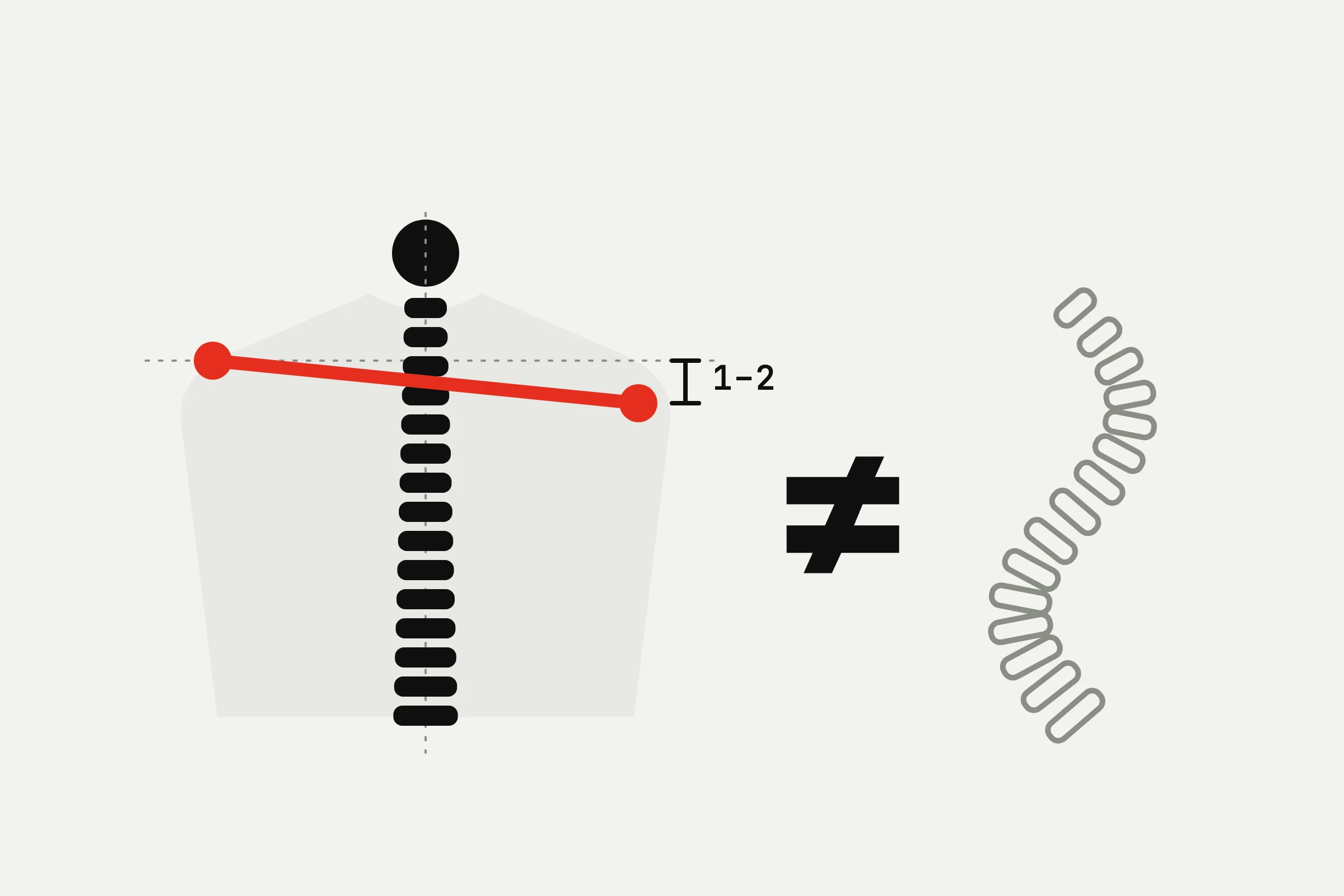
Lisi, of the IMT Varrone institute in Cassino (Italy), writes a narrative review, with no new sample or measurement. He starts from an old observation: good tennis players often show a lower dominant shoulder, sometimes with slight deviations of the spine. These observations fed the hypothesis that the asymmetry could signal scoliosis. He recalls that later studies did not show a significant correlation between a lowered shoulder and true scoliosis: the deviations, occasionally seen, were slight, often flexible and posture-dependent, and not always oriented toward the dominant arm, which in his view is incompatible with the definition of structural scoliosis (a fixed, three-dimensional deformity of the spine, with rotation of the vertebrae, that persists whatever the posture).
He then reviews two old explanations of the lower shoulder, repeated stretching of the muscles that lift the shoulder and the weight of the enlarged arm, and criticises them: the shoulder blade is actively stabilised, a drop of about 1 to 2 cm is unlikely to lengthen those muscles pathologically, resting position depends mainly on muscle tone rather than on gravity, and the arm-weight hypothesis seems to him biomechanically implausible. The author proposes instead their own framework, published in 2007: very fast rotations of the shoulder promote hypertrophy and strength dominance of the internal rotators (pectoralis major, latissimus dorsi, teres major, subscapularis), while the external rotators and the muscles that stabilise the shoulder blade are tested in braking. He relies on cited studies: the serve and forehand make up about 70 to 80% of shots in a match, peaks of more than 2,000 degrees per second have been reported during the acceleration of the serve in elite players, and thoracic kyphosis and the oblique orientation of the shoulder blade make the mechanical conditions of the external rotators less favourable (an unfavourable length–tension relationship).
- Our assessment
- Level of evidence : 2 out of 5 · Framework & review
This is a narrative review that presents no new data. The conclusion rests mostly, going by the reference list, on older work (1976 to 2007), on electromyography and isokinetic strength studies, and on the author’s own 2007 book, cited several times. No sample, no follow-up of players, and no measure of the effect of the proposed exercises are given.
This level does not say the idea is wrong: it says how well it is demonstrated.
The ideas, one by one
- 01
Tennis shapes an asymmetric body
- 02
A very fast movement, repeated
- 03
Muscles that push, muscles that brake
- 04
The old explanations are called into question
- 05
A flexible asymmetry is not a structural scoliosis
- 06
The right order: shoulder blade first, then arm
- 07
Screen a function, not a posture
- 08
Explain, to avoid medicalising too early
For subscribers
The full note, linked to the workshop
Each idea in detail, on-court advice with its diagrams, ready-to-run drills, the coach’s view and the article’s limits.
- 8 ideas in detail
- 21 on-court tips
- 6 workshop drills
Keywords
Further reading
On Seconde Balle
- The “shoulder” drills →Observe, strengthen, serve in slow motion: this note’s ideas, drawn in the workshop.
- Injury-prevention drills →Drills that work on prevention, to slip into the warm-up or the end of a session.
- Programmes for teens →Where the subject comes up most often: teen sessions with some fitness work.
- For clubs →A shared language between coaches, parents and club officers for talking about a shoulder without alarm.
- All notes by Rodolfo Lisi →Ministry of Education and Merit, IMT Varrone, Cassino, Italy
- Notes on « Biomechanics » →Articles for coaches
- Notes on « Strength & conditioning » →Articles for coaches
- Notes on « Juniors » →Articles for coaches
- Notes on « Parents » →Articles for coaches
In the journal
- Throw at a target, serve faster? A Hungarian pilot study →The serve puts the shoulder through very fast rotation (peaks of over 2,000°/s have been reported at acceleration in elite players); Dobos studies a one-handed ball throw at a target, whose speed is linked to serve speed (r = 0.58).
- Tall and short: two ways to reach the same level →Another article on the player’s body: Lehecka describes a loss of internal rotation as a cost of power in one player, which nuances Lisi, for whom a common adaptation can become something to watch when the deficit is excessive or one-sided.
- The game development pathway: six leaps, and what each one needs →Same issue · Hrvoje Zmajic
- Executive functions: training the head to stay clear →Same issue · Francesco Di Muccio, Lionel Grossenbacher
- Break points: the points that get saved are short points →Same issue · Andrej Grubisic, Nauman Haq, Robert Raguz, Rafael Martínez-Gallego
- Club culture: what national federations can teach a club →Same issue · Ana Piquer Piquer, Manrique Rodríguez Campos, Andrés Crespo Dualde
- Using time pressure in your sessions: 7 reasons →Same issue · Luke Regan
- Deception in tennis: fooling, and not being fooled →Same issue · William O’Connell
- Women players at the club: obstacles that are not only on the court →Same issue · Yannick Zaputovich
Also worth reading
- Kibler (1998), The role of the scapula in athletic shoulder function. American Journal of Sports Medicine: the role of the shoulder blade in the athlete’s shoulder function. DOI
- Kibler et al. (2007), Muscle activation in coupled scapulohumeral motions in the high performance tennis serve. British Journal of Sports Medicine: how the shoulder-blade and rotator-cuff muscles switch on during the serve. DOI
- Johnson et al. (2018), Glenohumeral internal rotation deficit and injuries: a systematic review and meta-analysis. Orthopaedic Journal of Sports Medicine: loss of internal rotation at the shoulder and injuries. DOI
- Keller et al. (2020), Injury and training history are associated with glenohumeral internal rotation deficit in youth tennis athletes. BMC Musculoskeletal Disorders: the same subject in young tennis players. DOI
- Negrini et al. (2018), 2016 SOSORT guidelines: orthopaedic and rehabilitation treatment of idiopathic scoliosis during growth. Scoliosis and Spinal Disorders: the reference the article uses to tell structural scoliosis from functional asymmetry. DOI
- All notes →