Tall and short: two ways to reach the same level
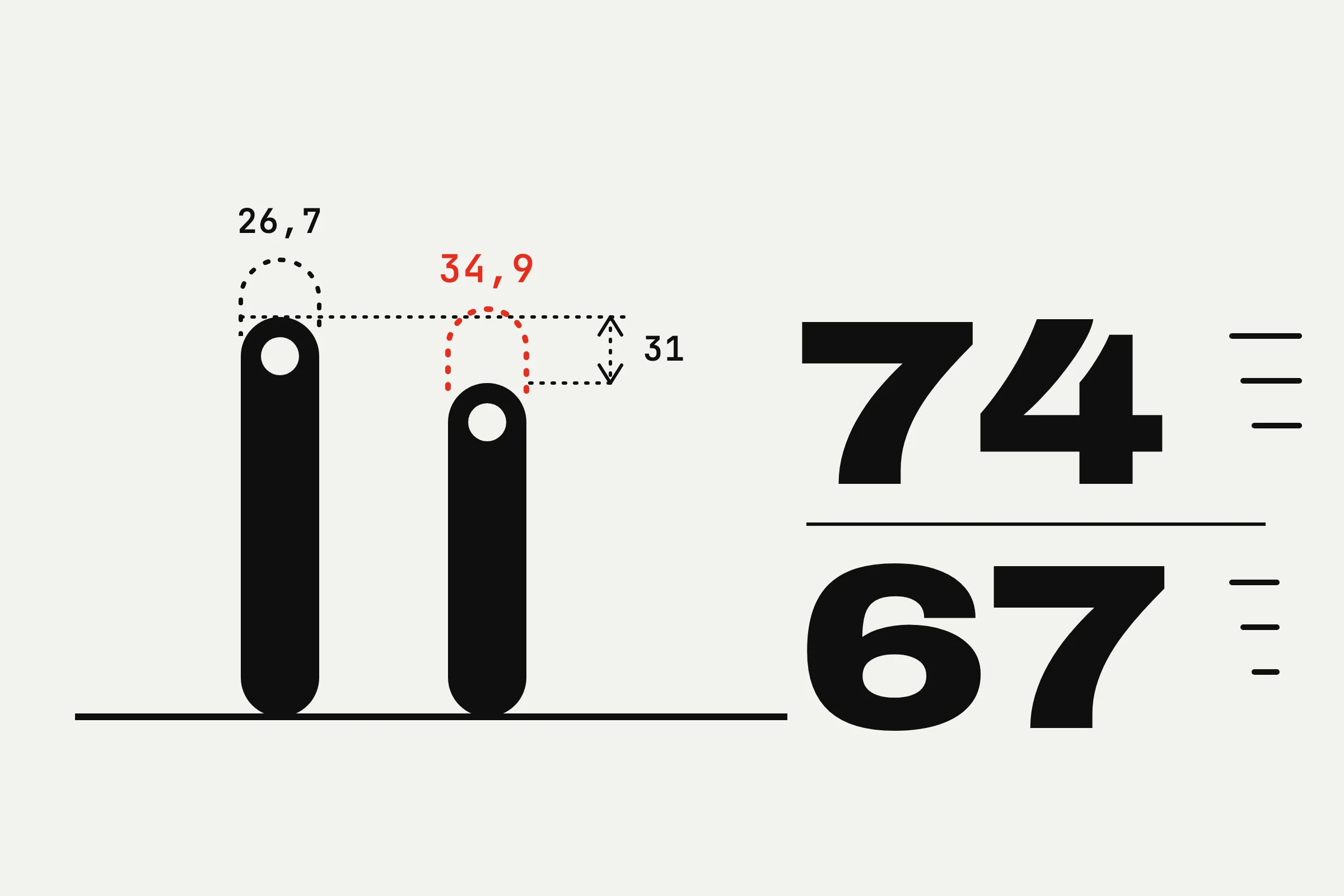
Two players from the same American college team, one 188 cm and one 157 cm, take the same physical check and have one set each filmed. Bryan Lehecka describes two almost opposite ways of winning points, which, he suggests, are paid for differently in the body.
Bryan J. Lehecka (Wichita State University, United States) LinkedIn · 2026 · ITF Coaching & Sport Science Review n° 98
Based on Bryan J. Lehecka (2026), Reaching the baseline: A comparative case study of anthropometric extremes in Division I female tennis players, ITF Coaching & Sport Science Review, vol. 34, n° 98, p. 16-20.
Download the article (PDF) Read the original article
DOI 10.52383/itfcoaching.v34i98.742 · CC BY 4.0
Wednesday, 6 pm. The competition group has four young players, including a tall boy of 6 ft 3 and a girl who barely tops 5 ft 1. The coach has planned the same warm-up, the same serving set and the same core programme for everyone. By the end, the tall boy serves from way up high but drags as soon as he has to change direction, and the small girl returns everything but complains about her shoulder.
This scene is our illustration, not the article’s. Lehecka starts from a gap in the literature: most group studies blur individual differences and few works compare two players of opposite builds. So the study looks closely at two players from the same university team: same tests, same playing level, and yet two games and two bodies that do not look alike. He is not looking for a single model player, he describes two paths.
In 2 minutes
The starting point is a familiar debate. With the move from wood to graphite, and changes in surfaces and balls, tennis has become a power game, and the average height of top women players keeps rising. The “taller is better” argument rests mainly on the serve: according to the prevailing model, hitting from higher opens the window over the net and allows a faster serve with less effort, while a shorter player has to rely more on spin to bring the ball down. Yet college rosters remain very varied. The author cites Kovacs (2007), for whom the kinetic chain, from the ground to the racket, is a great equalizer. He adds that a lower centre of mass often brings more agility, balance and change-of-direction speed, and that more explosive legs can make up for shorter levers. Most group studies blur these individual differences: hence the idea of comparing two extreme cases.
Lehecka, of Wichita State University in the United States, runs a case study: two Division I college players from the same team, chosen so that their builds are as opposite as possible (the author speaks of the 99th and 5th percentiles). Subject A is 22, 188 cm and 79.4 kg, an ectomorphic/mesomorphic blend according to the author; she plays aggressive first-strike tennis. Subject B is 20, 157 cm and 60 kg, a compact mesomorphic build; she is a counter-puncher who relies on movement and consistency. A has three years of Division I, B has two.
- Our assessment
- Level of evidence : 1 out of 5 · Practitioner experience
This is a case of two people, with one set filmed each. It describes two profiles very well, but it allows no generalisation, either to club players or even to other college players. The explanations (rotational inertia, shorter lever) are interpretations, not measurements.
This level does not say the idea is wrong: it says how well it is demonstrated.
The ideas, one by one
- 01
No single profile
- 02
Leverage and geometry
- 03
Power from the ground
- 04
The return, the short player’s strength
- 05
Each pays in their own way
- 06
Individualise session and recovery
- 07
Field measures
For subscribers
The full note, linked to the workshop
Each idea in detail, on-court advice with its diagrams, ready-to-run drills, the coach’s view and the article’s limits.
- 7 ideas in detail
- 17 on-court tips
- 8 workshop drills
Keywords
Further reading
On Seconde Balle
- Drills for this profile →Jump, pelvis, trunk, shoulder and the two-profile game, drawn and animated in the workshop.
- Adult blocks: play better matches →Six sessions to build a game that fits your own build, not someone else’s.
- A game plan before a match that matters →Three rules, a plan B, twenty minutes on video to rehearse them: a plan built on what you can do.
- For clubs →Groups where everyone has a different build: one shared workshop for the whole team.
- All notes by Bryan J. Lehecka →Wichita State University, United States
- Notes on « Biomechanics » →Articles for coaches
- Notes on « Strength & conditioning » →Articles for coaches
- Notes on « Tactics » →Articles for coaches
In the journal
- A lower shoulder in a player: tennis adaptation, or a sign of scoliosis? →The internal-rotation deficit Lehecka reports is easier to read with Lisi’s distinction between a functional adaptation in tennis players and a pathology.
- Throw at a target, serve faster? A Hungarian pilot study →Both pieces are about the serve: here the body’s leverage, in Dobos a one-handed ball throw at a target, whose speed is linked to serve speed (r = 0.58).
- The game development pathway: six leaps, and what each one needs →Same issue · Hrvoje Zmajic
- Executive functions: training the head to stay clear →Same issue · Francesco Di Muccio, Lionel Grossenbacher
- Break points: the points that get saved are short points →Same issue · Andrej Grubisic, Nauman Haq, Robert Raguz, Rafael Martínez-Gallego
- Club culture: what national federations can teach a club →Same issue · Ana Piquer Piquer, Manrique Rodríguez Campos, Andrés Crespo Dualde
- Using time pressure in your sessions: 7 reasons →Same issue · Luke Regan
- Deception in tennis: fooling, and not being fooled →Same issue · William O’Connell
- Women players at the club: obstacles that are not only on the court →Same issue · Yannick Zaputovich
Also worth reading
- Baiget, Corbi and López (2023), Influence of anthropometric, ball impact and landing location parameters on serve velocity in elite tennis competition, Biology of Sport: the link between height and serve speed that Lehecka cites. DOI
- Fett, Ulbricht and Ferrauti (2020), Impact of physical performance and anthropometric characteristics on serve velocity in elite junior tennis players, Journal of Strength and Conditioning Research: what Lehecka draws from it: shorter players must often rely on varying location and spin rather than pure speed. DOI
- Ellenbecker, Roetert, Bailie, Davies and Brown (2002), Glenohumeral joint total rotation range of motion in elite tennis players and baseball pitchers, Medicine & Science in Sports & Exercise: shoulder rotation in elite players (the article’s list wrongly gives the American Journal of Sports Medicine). DOI
- All notes →