Executive functions: training the head to stay clear
Holding back a reflex, remembering an instruction, changing plan: three mental abilities you can train with a cone, a colour or a word from the coach. Di Muccio and Grossenbacher offer twelve examples.
Francesco Di Muccio (EDGE International, Brain & Body Focus, Switzerland) LinkedIn · Lionel Grossenbacher (EDGE International, Brain & Body Focus, Switzerland) LinkedIn · 2026 · ITF Coaching & Sport Science Review n° 98
Based on Francesco Di Muccio, Lionel Grossenbacher (2026), From Brain to Court: How Executive Functions Shape Self-Regulation in Tennis, ITF Coaching & Sport Science Review, vol. 34, n° 98, p. 11-15.
Download the article (PDF) Read the original article
DOI 10.52383/itfcoaching.v34i98.744 · CC BY 4.0
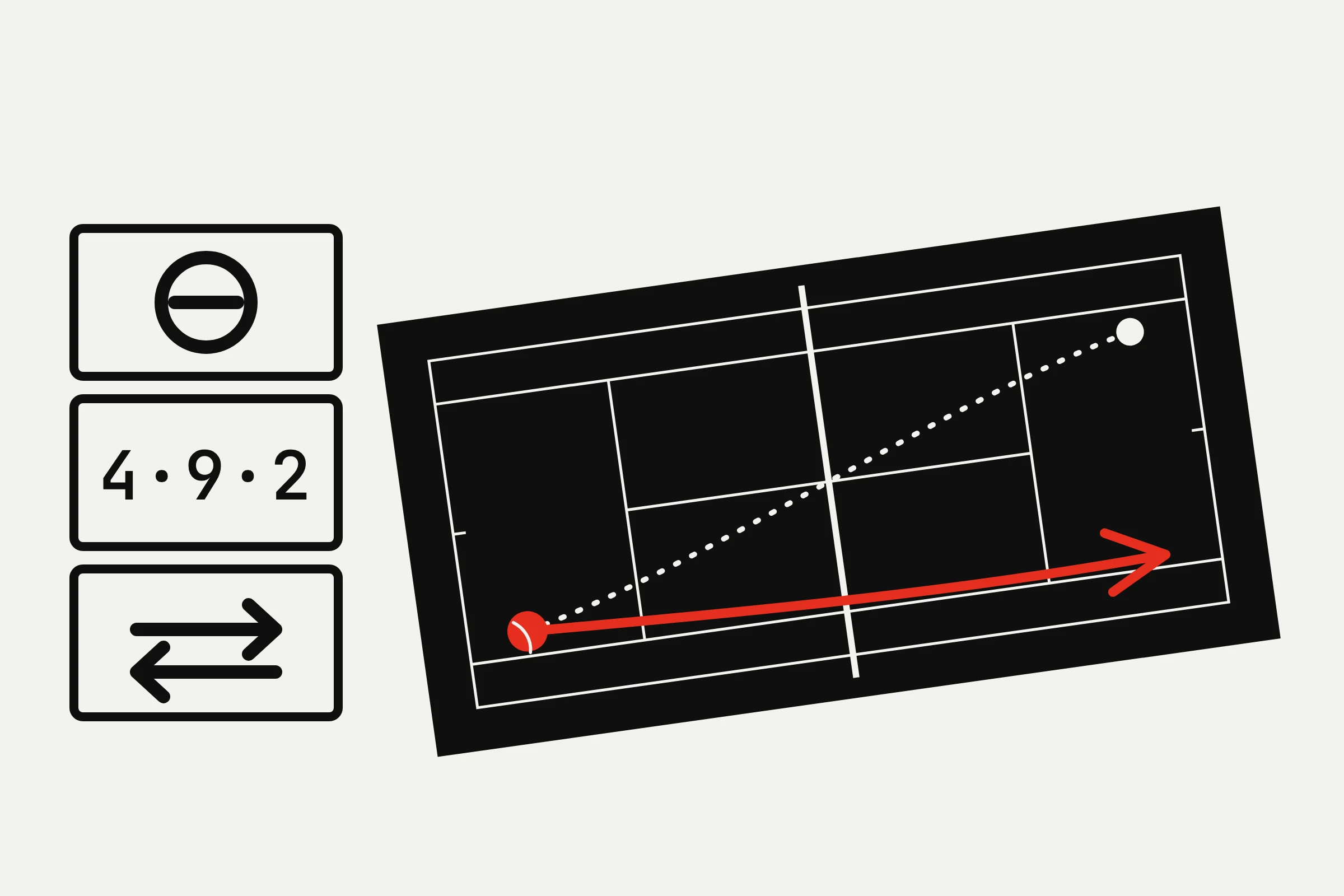
Thursday, 6.30 pm, a group of four adults. One player’s crosscourt is flawless, until they are asked to hit down the line on a word from the coach: they stick with crosscourt, or hesitate and miss. It is not a forehand problem. They cannot hold back a reflex, or change intention at the right moment.
The article does not tell this scene, it is our illustration, but it gives the key. Di Muccio and Grossenbacher are interested in what happens “behind the scenes”: executive functions. They explain that these can be trained in regular practice, by playing on cues, rules and contextual demands.
In 2 minutes
Di Muccio and Grossenbacher are affiliated with EDGE International (Brain & Body Focus), in Switzerland. Their article is a conceptual and narrative review: a synthesis of cognitive neuroscience and sport psychology research from which they draw practical implications for coaches.
They discuss three executive functions: inhibitory control (resisting an impulse or frustration), working memory (keeping information active while playing) and cognitive flexibility (changing strategy when needed). These act on play directly (making decisions, adapting tactics) and indirectly through self-regulation, which the authors split into three: regulating attention, emotions and effort.
The research cited points the same way. Athletes in “open” sports, where the environment keeps changing, like tennis, seem to have better executive functions than those in “closed” sports. Young players with higher executive scores improved more in the rankings over eighteen months. The authors suggest that these capacities may facilitate learning, tactical adaptation and long-term skill consolidation. And in university players, a decline in executive functions during an exercise went with lower second-serve accuracy.
On attention, the authors cite studies and a meta-analysis: the latter suggests that athletes generally do better than non-athletes in inhibition and attention tasks, and one study shows that good working memory helps keep focus in dynamic tasks. On emotions, better working memory supports reappraising a situation, and greater flexibility goes with better regulation under stress. They also note that, in competition, self-regulation often separates consistent players from those whose level fluctuates.
Finally, they give twelve drill examples (four per function) and dosage guidelines: demanding drills may be introduced once or twice a week, with a way of tracking mental load and an explanation of each drill’s aim. Their conclusion: executive-function work may complement technical, physical and psychological approaches rather than stand alone; the causal link with long-term progress remains insufficiently established.
- Our assessment
- Level of evidence : 2 out of 5 · Framework & review
A narrative, conceptual review with no new data. The links to tennis rest on few tennis studies: the article cites only two. Most studies of executive functions in sport rely on laboratory-based or generic tasks, which may only partly reflect real tennis; the authors themselves acknowledge that the causal link with long-term progress remains insufficiently established.
This level does not say the idea is wrong: it says how well it is demonstrated.
The ideas, one by one
- 01
Three functions not to confuse
- 02
Tennis already calls on them
- 03
Attention depends on executive control
- 04
Emotions are held back and reframed
- 05
Effort wears down with the head
- 06
Dose, measure, explain
- 07
Change the rule, the signal, the task
For subscribers
The full note, linked to the workshop
Each idea in detail, on-court advice with its diagrams, ready-to-run drills, the coach’s view and the article’s limits.
- 7 ideas in detail
- 19 on-court tips
- 12 workshop drills
Keywords
Further reading
On Seconde Balle
- The “executive functions” drills →The article’s examples, drawn and animated in the workshop.
- Adult blocks: play better matches →Sessions where rules and signals work the head as much as the stroke.
- A game plan before a match that matters →Three rules, a plan B, twenty minutes on video to rehearse them: working memory at work.
- For clubs →One drill workshop for the whole teaching team, with these mental sequences.
- All notes by Francesco Di Muccio →EDGE International, Brain & Body Focus, Switzerland
- All notes by Lionel Grossenbacher →EDGE International, Brain & Body Focus, Switzerland
- Notes on « Psychology » →Articles for coaches
- Notes on « Coaching methods » →Articles for coaches
- Notes on « Tactics » →Articles for coaches
In the journal
- Using time pressure in your sessions: 7 reasons →Two constraint levers with different effects on working memory: for Regan, time pressure may help bypass explicit knowledge; here, rules and signals on the contrary call on working memory. Choose according to the aim, do not stack them.
- Break points: the points that get saved are short points →Holding your plan and composure on decisive points: break points are a moment where self-regulation may show in a match (Grubisic’s article measures rally length there, not self-regulation).
- The game development pathway: six leaps, and what each one needs →Same issue · Hrvoje Zmajic
- Tall and short: two ways to reach the same level →Same issue · Bryan J. Lehecka
- A lower shoulder in a player: tennis adaptation, or a sign of scoliosis? →Same issue · Rodolfo Lisi
- Club culture: what national federations can teach a club →Same issue · Ana Piquer Piquer, Manrique Rodríguez Campos, Andrés Crespo Dualde
- Throw at a target, serve faster? A Hungarian pilot study →Same issue · Károly Dobos, János Péter Tóth, Katalin Orbán-Sebestyén, Csaba Ökrös
- Deception in tennis: fooling, and not being fooled →Same issue · William O’Connell
- Women players at the club: obstacles that are not only on the court →Same issue · Yannick Zaputovich
Also worth reading
- Ishihara, Kuroda and Mizuno (2019), Competitive achievement may be predicted by executive functions in junior tennis players. The eighteen-month follow-up of young players cited by the article. DOI
- Kuroda, Ishihara and Mizuno (2023), Association between perceived exertion and executive functions with serve accuracy among male university tennis players. Pilot study on mental fatigue and the second serve. DOI
- Simonet, Beltrami and Barral (2023), Inhibitory control expertise through sports practice: a scoping review. Athletes’ inhibitory control compared with non-athletes’. DOI
- Marcora, Staiano and Manning (2009), Mental fatigue impairs physical performance in humans. A study on mental fatigue and endurance, cited by the article. DOI
- All notes →