Deception in tennis: fooling, and not being fooled
A drop shot prepared like a drive, a step back that invites a short slice, a ball played behind an opponent who has already set off. William O’Connell offers definitions, a taxonomy and training ideas for the coach.
William O’Connell (ITF Coach of High-Performance Players, United States) · 2026 · ITF Coaching & Sport Science Review n° 98
Based on William O’Connell (2026), Deception in Tennis: An Ecological Dynamics Perspective, ITF Coaching & Sport Science Review, vol. 34, n° 98, p. 49-55.
Download the article (PDF) Read the original article
DOI 10.52383/itfcoaching.v34i98.767 · CC BY 4.0
Thursday, 8.30 pm, a team championship match. Across the net, a player your age winds up a baseline forehand, you set off for the deep ball… and the ball lands just behind the net. You had seen nothing. You go back, a little stung, and on the next point you stay rooted to the baseline: it goes deep, behind you.
This scene is our own illustration: it does not come from the article. William O’Connell, an ITF coach of high-performance players, notes that deception appears to have received little attention from coaches and researchers, and sets out to study its mechanics: how to deceive, how to defend, and how a coach can build both in the same session.
In 2 minutes
Our reading: the article is a framing text, with no new experiment. It rests on ecological dynamics, a way of describing movement in which player and opponent shape each other, and where you perceive to act but also act to perceive. It starts by recalling that most research has focused on anticipation, much less on deception, and that it often studies perception and movement separately, away from game-like conditions. It also rests on the idea that a movement response also engages the dorsal visual system (vision for action), whereas a verbal response engages only the ventral one (vision for perception), and on the study by Rosker and Majcen Rosker (2021): on serve return, international players adapt their visual search better than national players.
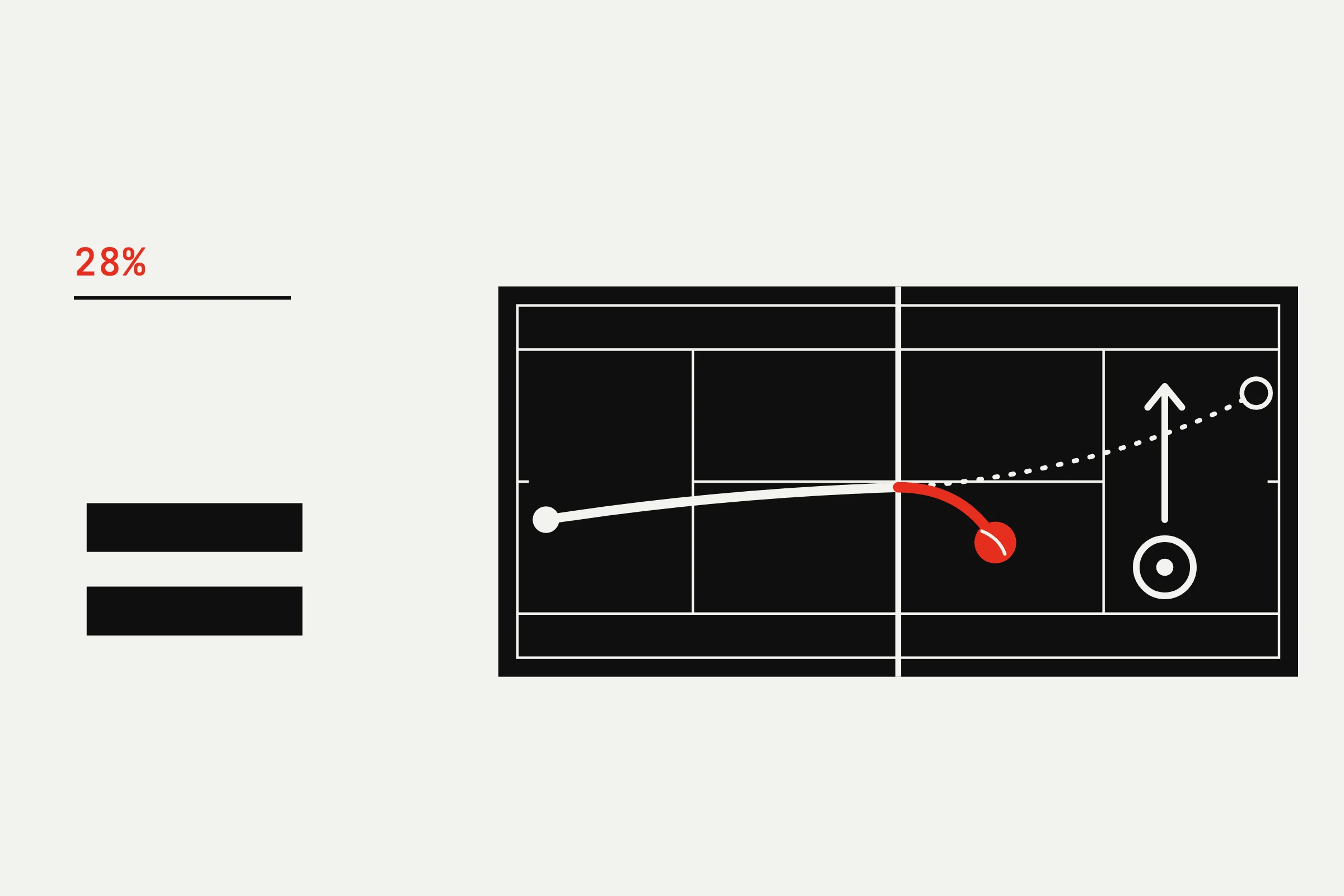
The author first gives some figures. A frame-by-frame analysis of the 2019 Wimbledon final (Dimic et al.) finds deception on 28% of baseline shots. Deceptive shots led to an advantageous point dynamic in 56% of cases, against 38% for non-deceptive shots, and the opponent’s anticipatory responses were wrong in 85% of cases, against 23% on a genuine shot. The author also recalls that research suggests professional players react to ball flight with about 100% accuracy from 160 milliseconds after the opponent’s contact (Triolet et al.).
The article then offers a vocabulary. A successful deception brings the opponent into a movement that is then exploited. It falls into three forms: deceit (offering a functional but misleading possibility), disguise (delaying the informative cue as long as possible) and distraction (drawing attention away from what matters). It can be played by the player about to hit (active role) or, less often, by the one receiving (contra-active role, through gestures and positioning). It can be sequential (the false movement is finished before the real one) or merged into the real stroke (simultaneous). In the author’s terms, reworded: anticipating is an attempt to improve your own possibilities for action; deceiving, an attempt to undermine the opponent’s.
- Our assessment
- Level of evidence : 2 out of 5 · Framework & review
This is a framing article that assembles work from varied fields or on specific cases: a single top-level match for the deception figures, one study of professional players for the time windows. The activities proposed are untested. Level 2 says exactly that: a serious framework and review, not proof that these drills make players improve.
This level does not say the idea is wrong: it says how well it is demonstrated.
The ideas, one by one
- 01
Two halves of one skill
- 02
Three forms of deception
- 03
Figures from a single match
- 04
Active and contra-active
- 05
The time windows
- 06
Timing and the racket
- 07
Reading live, not only by heart
- 08
Train as you play
For subscribers
The full note, linked to the workshop
Each idea in detail, on-court advice with its diagrams, ready-to-run drills, the coach’s view and the article’s limits.
- 8 ideas in detail
- 29 on-court tips
- 13 workshop drills
Keywords
Further reading
On Seconde Balle
- The “deception” drills →This note’s ideas, drawn and animated in the workshop.
- The “anticipation” drills →Reading the opponent without leaving too early: the other half of deception.
- Adult blocks: play better matches →Six sessions where time, score and opponent add the pressure.
- A game plan before a match that matters →Three rules, a plan B, twenty minutes on video to rehearse them.
- For clubs →Workshops for competition slots, and one workshop for the whole team.
- All notes by William O’Connell →ITF Coach of High-Performance Players, United States
- Notes on « Tactics » →Articles for coaches
- Notes on « Coaching methods » →Articles for coaches
- Notes on « Biomechanics » →Articles for coaches
In the journal
- Using time pressure in your sessions: 7 reasons →Both stress the role of time pressure in training: for O’Connell, without it, anticipation is superfluous.
- The game development pathway: six leaps, and what each one needs →Same issue · Hrvoje Zmajic
- Executive functions: training the head to stay clear →Same issue · Francesco Di Muccio, Lionel Grossenbacher
- Tall and short: two ways to reach the same level →Same issue · Bryan J. Lehecka
- A lower shoulder in a player: tennis adaptation, or a sign of scoliosis? →Same issue · Rodolfo Lisi
- Break points: the points that get saved are short points →Same issue · Andrej Grubisic, Nauman Haq, Robert Raguz, Rafael Martínez-Gallego
- Club culture: what national federations can teach a club →Same issue · Ana Piquer Piquer, Manrique Rodríguez Campos, Andrés Crespo Dualde
- Throw at a target, serve faster? A Hungarian pilot study →Same issue · Károly Dobos, János Péter Tóth, Katalin Orbán-Sebestyén, Csaba Ökrös
- Women players at the club: obstacles that are not only on the court →Same issue · Yannick Zaputovich
Also worth reading
- Panten, Loffing, Baker and Schorer (2019), Extending research on deception in sport: combining perception and kinematic approaches. The framework of deceit, disguise, and the active and contra-active roles, used by O’Connell. DOI
- Dimic, Furuya and Kanosue (2023), Importance of disguising groundstrokes in a match between two top tennis players. The frame-by-frame analysis of the 2019 Wimbledon final cited by the article (28% of baseline shots deceptive). DOI
- Triolet, Benguigui, Le Runigo and Williams (2013), Quantifying the nature of anticipation in professional tennis. The four time windows around the opponent’s stroke, cited heavily in the article (whose reference list is incomplete on this entry: the reference was retrieved here from Crossref). DOI
- Ramsey, Dicks, Hope, Spence and Reddy (2022), Maximising grip on deception and disguise. The “grip” on the interaction framework, which the article uses for deception and anticipation alike. DOI
- Buszard (2022), On learning to anticipate in youth sport. What the article takes from it: children’s anticipation does not necessarily develop on its own, and the idea of antifragility. DOI
- Otte, Millar and Klatt (2019), Skill training periodization in “specialist” sports coaching. The skill-training periodization framework the article draws on to schedule deception and anticipation according to the learning phase and the calendar. DOI
- All notes →