Break points: the points that get saved are short points
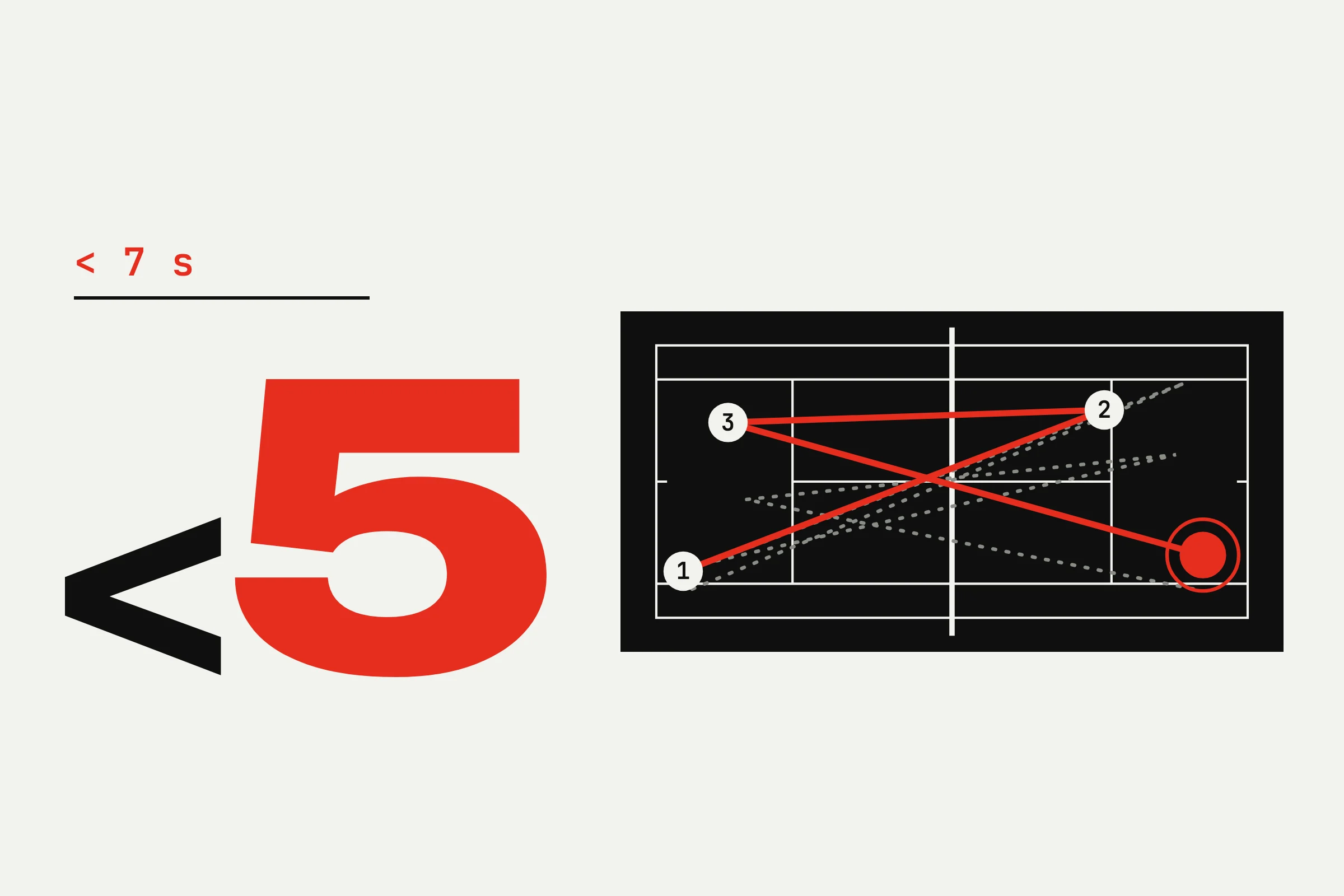
Five shots, seven seconds. Grubisic and co-authors charted more than 500 break points in tour-level matches: the ones that get saved are mostly played short.
Andrej Grubisic (Tennis Club Vierjahreszeiten (TCVJ), Germany) · Nauman Haq (Pakistan Tennis Federation (PTF) ; TriStar Education, Pakistan) · Robert Raguz (Tennis Association of Bosnia and Herzegovina ; International Tennis Federation (ITF), Grand Slam Player Development Programme (GSPDP), Bosnia and Herzegovina) · Rafael Martínez-Gallego (Research Group on Sports Technique and Tactics, University of Valencia, Spain) LinkedIn · 2026 · ITF Coaching & Sport Science Review n° 98
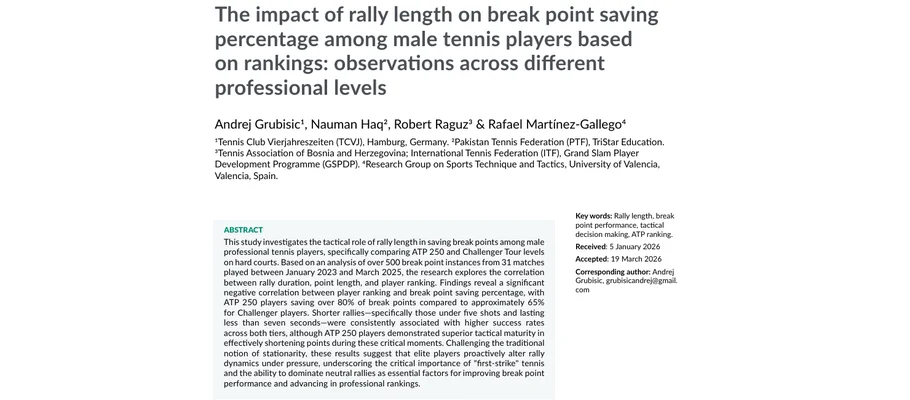
Based on Andrej Grubisic, Nauman Haq, Robert Raguz, Rafael Martínez-Gallego (2026), The impact of rally length on break point saving percentage among male tennis players based on rankings: observations across different professional levels, ITF Coaching & Sport Science Review, vol. 34, n° 98, p. 27-33.
Download the article (PDF) Read the original article
DOI 10.52383/itfcoaching.v34i98.750 · CC BY 4.0
A scene we imagined ourselves. Sunday morning, league match. 4-4 in the third set, 30-40 on the serve of a player you have coached for two years. He serves, the return is deep, and off he goes into a fifteen-ball rally, drifting further and further behind the baseline. This time he cracks. At the changeover he says: “I just can’t play these points”.
Grubisic, Haq, Raguz and Martínez-Gallego ask whether these points are won, or lost, depending on their length. They ran no experiment. They counted, match after match, on professional break points, how many shots and how many seconds the saved points lasted, and the lost ones.
In 2 minutes
The study is observational and retrospective. It covers 31 men’s singles matches on hard courts played between January 2023 and March 2025: 16 at ATP 250 level and 15 on the Challenger Tour, chosen to contain enough break points (unfinished matches excluded). In all, more than 500 break points against the server were charted: 226 at ATP 250 and 276 at Challenger level. For each, the authors note the number of shots (serve included: an ace counts as one shot, a double fault as zero), the duration of the point in seconds and the server’s ATP ranking. For each match they compute the percentage of break points saved, then correlations and regressions for each tour.
The article links ranking, rally length and the percentage of break points saved. On average, ATP 250 players save more than 80% of their break points, Challenger players about 65%. According to the authors, ranking explains a larger share of the variance in break points saved at ATP 250 (R² = 0.53) than at Challenger level (R² = 0.23) (these values are printed on the duration figure, see the limits). Point duration is also negatively linked to the percentage saved, in both tours; a paragraph of the text, which seems to be about this relationship, calls it more pronounced at ATP 250 (R² = 0.54) than at Challenger level (R² = 0.22). Players who save more than 75% of their break points do so mostly in points lasting under seven seconds, and a large share of lost break points fall on longer points. Finally, splitting points of fewer than five shots from points of more than five shots the authors note that short points keep a low percentage of break points lost, generally under 30%, at every ranking; long points push that rate up, especially outside the top 100.
- Our assessment
- Level of evidence : 3 out of 5 · Observational study
A retrospective observation of 31 matches, with correlations and regressions. It is solid for describing what happens on hard courts at ATP 250 and Challenger level, but it does not prove that players should shorten points: those who save break points may also be those who serve and return better, and it covers only men, on hard courts.
This level does not say the idea is wrong: it says how well it is demonstrated.
The ideas, one by one
- 01
The short point is the plan
- 02
Five shots, seven seconds
- 03
One simple instruction might lighten the mental load
- 04
Stationarity in doubt
- 05
The gap between tours opens after five shots
- 06
Second serve: win the neutral rally
- 07
Short is not universal
For subscribers
The full note, linked to the workshop
Each idea in detail, on-court advice with its diagrams, ready-to-run drills, the coach’s view and the article’s limits.
- 7 ideas in detail
- 16 on-court tips
- 8 workshop drills
Keywords
Further reading
On Seconde Balle
- The “break point” drills →This note’s ideas, drawn and animated in the workshop.
- Adult blocks: play better matches →Six sessions where time, score and opponent add the pressure.
- A game plan before a match that matters →Three rules, a plan B, twenty minutes on video to rehearse them: this article’s simple instruction, in practice.
- For clubs →Sessions for competitors and teams, and one workshop for all the club’s coaches.
- All notes by Andrej Grubisic →Tennis Club Vierjahreszeiten (TCVJ), Germany
- All notes by Nauman Haq →Pakistan Tennis Federation (PTF) ; TriStar Education, Pakistan
- All notes by Robert Raguz →Tennis Association of Bosnia and Herzegovina ; International Tennis Federation (ITF), Grand Slam Player Development Programme (GSPDP), Bosnia and Herzegovina
- All notes by Rafael Martínez-Gallego →Research Group on Sports Technique and Tactics, University of Valencia, Spain
- Notes on « Tactics » →Articles for coaches
- Notes on « Psychology » →Articles for coaches
- Notes on « Adults & clubs » →Articles for coaches
In the journal
- Using time pressure in your sessions: 7 reasons →Same lever, seen from training: limiting the number of shots or the length of a point, and playing against a clock.
- Executive functions: training the head to stay clear →Grubisic and colleagues suggest that a simple instruction might lighten the mental load under pressure; that article deals with self-regulation.
- The game development pathway: six leaps, and what each one needs →Same issue · Hrvoje Zmajic
- Tall and short: two ways to reach the same level →Same issue · Bryan J. Lehecka
- A lower shoulder in a player: tennis adaptation, or a sign of scoliosis? →Same issue · Rodolfo Lisi
- Club culture: what national federations can teach a club →Same issue · Ana Piquer Piquer, Manrique Rodríguez Campos, Andrés Crespo Dualde
- Throw at a target, serve faster? A Hungarian pilot study →Same issue · Károly Dobos, János Péter Tóth, Katalin Orbán-Sebestyén, Csaba Ökrös
- Deception in tennis: fooling, and not being fooled →Same issue · William O’Connell
- Women players at the club: obstacles that are not only on the court →Same issue · Yannick Zaputovich
Also worth reading
- Reid, McMurtrie and Crespo (2010), The relationship between match statistics and top 100 ranking in professional men’s tennis: second serve and second-serve return, the two strongest predictors of a top-100 ranking. DOI
- O’Donoghue (2012), Break points in Grand Slam men’s singles tennis: how play changes on break points. DOI
- Meffert et al. (2018), Tennis serve performances at break points: serving on break points, with pointers for practice. DOI
- Prieto-Lage et al. (2018), a video-based system to identify play patterns, applied to break points (Nadal and Djokovic on clay). DOI
- Fitzpatrick et al. (2021), Investigating the most important aspect of elite grass court tennis: short points. DOI
- All notes →