Women players at the club: obstacles that are not only on the court
In a Buenos Aires tennis club, playing tennis was not the most accessible activity for many women members. Yannick Zaputovich explains what stood between them and playing, and how they went about it.
Yannick Zaputovich (University of Buenos Aires, Argentina) ORCID · 2026 · ITF Coaching & Sport Science Review n° 98

Based on Yannick Zaputovich (2026), Obstacles to female participation in a tennis club: a case study, ITF Coaching & Sport Science Review, vol. 34, n° 98, p. 56-60.
Download the article (PDF) Read the original article
DOI 10.52383/itfcoaching.v34i98.724 · CC BY 4.0
Saturday morning, at the club. On the terrace, a few members have coffee while their partner finishes a match. They are members, they pay their subscription, they know everyone. None has ever picked up a racket. Nobody forbade it: the courts are taken, the times they are offered fall at midday, and this week’s group is already formed.
This scene is our own illustration: it does not come from the article. Yannick Zaputovich carried out his fieldwork in a Buenos Aires club (2022 and 2024). Our reading: what he describes matters to every club coach; the obstacle to play is not always in the stroke or in motivation. It is in how the club is organised, and that is exactly what a coach can see from the edge of the court.
In 2 minutes
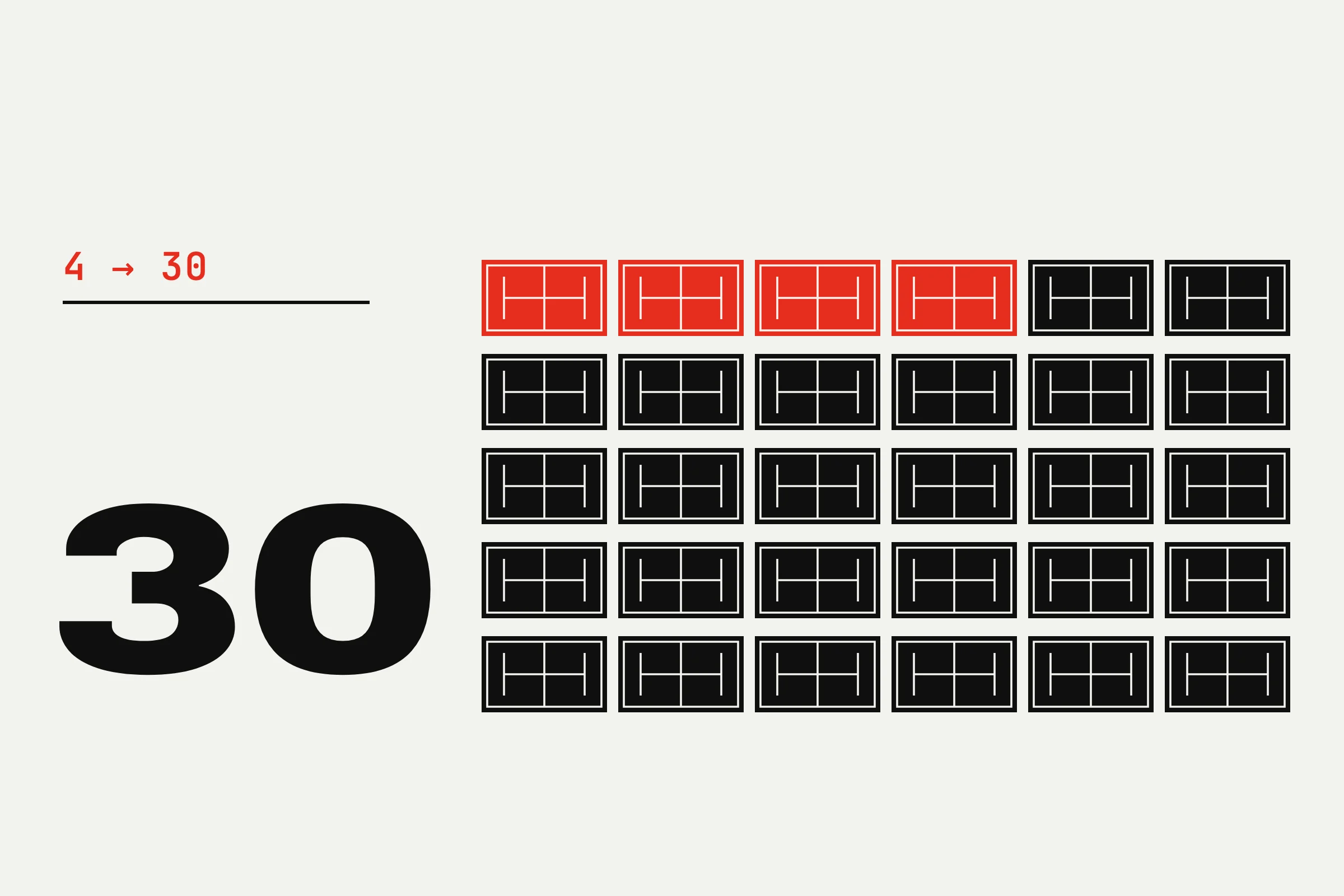
The starting point is national. In Argentina, tennis is one of the ten most played sports and one of the few open to women from the early twentieth century. Yet, according to the national survey, 5.5% of the population played in 2023, down from 6.2% in 2021, and racket sports remain more male (20.2% of men against 12.5% of women in 2021). Other reports (González & Brum, 2024) indicate a 117% rise in entries to Argentine federation tournaments between 2019 and 2024, and estimate that about 4.5 million people over the age of 5 played at least once in twelve months. Research in other contexts (Deelen et al., 2018) links being female to a higher likelihood of dropping out of tennis, even among young players, which suggests the barrier does not end with the first sign-up.
The author, from the University of Buenos Aires, carries out field research (ethnographic) in a tennis club in the city: 650 adult members (and about 200 minors), thirteen courts, no other sport. Between 2016 and 2023 women are on average 43% of adult members. But the club has two categories: “tennis members”, who can use the courts (62% men), and “social members”, who cannot (73% women over the period; the latest data indicate, in the article’s wording, that 61% of women are social members). As in many Buenos Aires clubs, registering the family earns a discount provided one member is a “tennis member”, a place most often held by a man, which, according to the author, shapes the place each member holds in the club. Since 2022 the share of women players with under four years’ membership has gone from 16% to 40%, which, the author says, may indicate that the newcomers arrive wanting to play.
- Our assessment
- Level of evidence : 3 out of 5 · Observational study
This is a qualitative case study in a single club, based on 20 interviews and observation. It describes very closely what happens in this club, but measures no effect and does not allow generalising, although, according to the author, these obstacles are most likely reproduced in other clubs with similar forms of sociability. It is most useful as a way of reading a club.
This level does not say the idea is wrong: it says how well it is demonstrated.
The ideas, one by one
- 01
Member does not mean player
- 02
Courts and times: very concrete obstacles
- 03
Getting into the club, getting into a group
- 04
The team keeps people
- 05
The fight over symbolic spaces
- 06
Little place in decisions
For subscribers
The full note, linked to the workshop
Each idea in detail, on-court advice with its diagrams, ready-to-run drills, the coach’s view and the article’s limits.
- 6 ideas in detail
- 29 on-court tips
- 5 workshop drills
Keywords
Further reading
On Seconde Balle
- Adult “club life” drills →Club events, doubles and matches: this note’s ideas, in the workshop.
- Adult programmes in the workshop →Blocks for beginners and recreational players: a frame for welcoming a group that is starting.
- For clubs →Running slots and welcoming newcomers: what Seconde Balle offers a club.
- Coaching formats →Group or remote coaching: a way to add a slot designed for those who cannot come at midday.
- All notes by Yannick Zaputovich →University of Buenos Aires, Argentina
- Notes on « Adults & clubs » →Articles for coaches
- Notes on « Coaching methods » →Articles for coaches
In the journal
- Club culture: what national federations can teach a club →A neighbouring angle, seen from above: how a tennis culture is built in a federation, where Zaputovich shows what a club’s culture can exclude.
- The game development pathway: six leaps, and what each one needs →Same issue · Hrvoje Zmajic
- Executive functions: training the head to stay clear →Same issue · Francesco Di Muccio, Lionel Grossenbacher
- Tall and short: two ways to reach the same level →Same issue · Bryan J. Lehecka
- A lower shoulder in a player: tennis adaptation, or a sign of scoliosis? →Same issue · Rodolfo Lisi
- Break points: the points that get saved are short points →Same issue · Andrej Grubisic, Nauman Haq, Robert Raguz, Rafael Martínez-Gallego
- Using time pressure in your sessions: 7 reasons →Same issue · Luke Regan
- Throw at a target, serve faster? A Hungarian pilot study →Same issue · Károly Dobos, János Péter Tóth, Katalin Orbán-Sebestyén, Csaba Ökrös
- Deception in tennis: fooling, and not being fooled →Same issue · William O’Connell
Also worth reading
- Johnston, Naylor, Campbell, Fitzmaurice and Ferkins (2022), The female-friendliness of New Zealand’s tennis clubs. Same journal, issue 87: how welcoming New Zealand’s clubs are to women players. Zaputovich quotes it on how resources are allocated. DOI
- Lake (2011), “They treat me like I’m scum”: social exclusion and established-outsider relations in a British tennis club. Economic incentives do not suffice to integrate newcomers. DOI
- Jeanes et al. (2021), Gender relations, gender equity, and community sports spaces. How certain everyday club practices marginalise women and girls despite equity efforts. DOI
- All notes →